Reflection & Activity 1: Teaching Philosophy
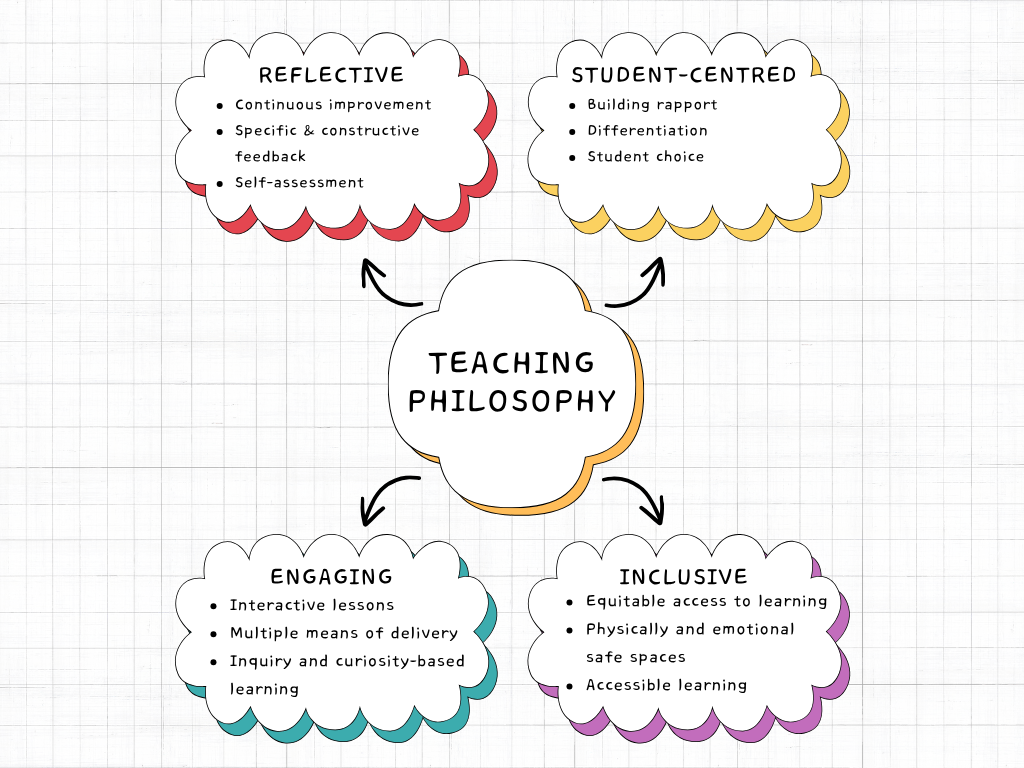
My teaching philosophy is centred on what I believe good teaching is. I believe a good teacher is someone who is not only effective in communicating curricular material, but also someone that helps facilitate and contribute to a student-centred, inclusive, reflective, and engaging environment in partnership with their students, so that everyone feels respected and safe enough to explore and ask questions. This environment should be provided to everyone, regardless of gender identity, sexual orientation, neurodiversity, diverse learning needs, or background.
I am not just a teacher, but also a learner in this environment, and I strive to work with my students to co-create a space of respect, growth, learning, and responsibility.
To implement this definition of good teaching, I believe that it is important to help facilitate and co-create a space where everyone is accountable for being respectful of each other and their identities, histories and cultures, learning needs, and interests.
Activity & Reflection 2: How I Meet Standard 9
Part 1: Practicum Debrief Questions
One thing I learned that I did not expect to was how to manage my classroom amidst external noises and stressors, as the classroom next door was quite loud and disruptive when I was trying to teach. In addition, the teacher next door was also quite loud, so it was an interesting opportunity to navigate this while I was doing my own teaching.
The best part of practicum was building rapport with students, and collaborating with other teachers. The worst part was the sheer quantity of marking I had to do, but it definitely encouraged me to explore different assessment methods.
A discipline part that was both humorous and stressful was an incident where students tried to play grad tag inside of the classroom, leading to a student on the ground in tears. I immediately shut down the incident, checked in with both the injured student and the instigators, and reported the incident immediately to my teacher mentor and the school administration. I also followed up with the students in the days following.
Part 2: Reflection
I attempt to meet Standard 9 of the Professional Standards by both explicitly tying back content to Indigenous Knowledge and the First Peoples’ Principles of Knowledge, but also in more subtle ways. I try to relate the principle of how learning supports the well-being of the self, the family, the community, the land, the spirits, and the ancestors, as well as the principle that learning is holistic, reflexive, reflective, experiential, and relational, in all of my lessons. An example of this would be a term project I gave my Biology 12 students, where students explored a piece of the course content in a context that they were interested in and could relate to. They specifically learned about how their topic can support or not support well-being, and this project helped them gain a more holistic understanding of the content and how it relates to the world around them. In this way, I try to incorporate these two principles, at minimum, and use them to guide my lesson plans, assignments, and activities. In the future, I would like to also bring in Indigenous Knowledge Keepers and incorporate Indigenous Knowledge in contexts beyond the ecological.
Reflection 3: Mock Interview
3 things I did well:
- I referenced a lot of examples from my practicum experience that helped highlight the key parts of my answers.
- I was able to respond to every question with a concrete example and answer.
- I presented myself confidently, even when I identified that there is a lot for me to still learn.
2 things I need to work on:
- I need to work on making my answers more concise, as I have a tendency to ramble when I get nervous and recall more things I want to talk about as I am talking.
- I need to better explain the result of my interventions (i.e., what students got out of it) instead of focusing on how I did it.
1 question I have about interviewing:
- What kind of hidden things are interviewers looking for? e.g., clothing, body language, etc.
Activity 3 & Reflection 4: Resume Workshop / Changes
10 things I think are important to include in my CV:
- A section for certification
- Prioritizing experience related to teaching
- Removing non-relevant experience
- Including practicum experience
- Including relevant references
- Including professional development
- Focused bullet points on what would be most relevant for teaching
- Organized by starting date
- Contact information
- Education / degrees
Reflection 5: Tell Me About Yourself
Notes about what I said:
- TC from Thompson Rivers University
- BSc from UBC and MEnvSc from U of T
- Excited to share my knowledge and skills with my students as I begin my career as a teacher
- Worked with grade 8s, grade 9s, grade 11s, and grade 12s in both the junior sciences and senior biologies.
- I planned lessons and units, managed the classroom by myself, and also supported diverse learners.
- My grade 9 class from my certifying practicum, for example, had 32 students, a third of which had ministry designation.
- This was a challenge but ultimately helped me develop strong classroom management skills.
- As a teacher, I enjoy creating engaging, student-centred, and curiosity-based activities to help reach my students.
Reflection 6: How I Meet Standard 7
A teaching area I would like to work on in the coming year is making my lessons more accessible to a wide variety of learners, especially including ELL students. I have already explored some translation options, but I would like to engage more effective strategies, as some of my students refused to use the aids for fear of being seen as an “other”.
I will learn once I leave the program by engaging in school and district-sponsored professional development opportunities, going to relevant conferences (e.g., Catalyst), and taking courses on my own.
I have already engaged in professional development outside of the BEd program in the following ways:
- Science Teachers Association Catalyst Conference – interact and connect with other science teachers
- Indigenous Canada – to better understand Indigenous perspectives on this land
- WHMIS certification – to be better equipped in a science classroom
- FOIPPA certification – to better understand my responsibilities under FOIPPA
I believe all of these experiences helped me understand my students better, and gave me more insight in how to run a science classroom.
Reflection 7: Key Takeaway from KTTA Presentation
One key takeaway that resonated with me during Laurel’s presentation today was that if there is a grievance, as a teacher we need to take our grievances to the union before taking it to administration. Perhaps it is because I have not worked in a union environment like this before, but I was surprised that you would not take your grievance straight to the employer. I suppose it makes sense, as the union is meant to help support you, and they can tell you the best way to approach your employer.
Reflection 8: Key Takeaway from 4 Directions Presentation
One key takeaway that resonated with me during Jordan’s presentation today was the importance of accessible education, and some insight into how to better bring Indigenous principles into the classroom. I really liked Jordan’s wheel graphic and how detailed it was, and will definitely use it as a guiding reference in my future practice, as well as for ideas for how I can incorporate Indigenous perspectives into each of my lessons. In addition, I will definitely take her perspective on flexible education with me, as this is something I have noticed with my own students and am seeking to emphasize further in future classrooms.
Reflection 9: Key Takeaway from TRUBOX Presentation & Why You Chose Teaching
The key takeaway from the TRUBOX presentation was how to set up my website effectively, especially because the website will be accessible after we leave TRU – this reinforced to me the importance of making a good website, since I can refer to it in future years. The more groundwork I lay now, the easier it will be to adapt the site in the future.
I chose to go into teaching because it is something I have always been interested in, and I really enjoy both face-to-face interactions and working with kids. I have been volunteering with kids for as long as I can remember, and I have had a few experiences during undergrad specifically where I had the opportunity to go into classrooms and teach that I look back on fondly. I also appreciate the opportunity to actually participate in my specialty and share my knowledge with students. All that considered, I figured I’d give it a shot, and I’m so glad that I did because working in classrooms has been phenomenal for me so far.
Activity 6 & Reflection 10: Key Takeaway from Make a Future Presentation & Collaboration
The key takeaway for this Make a Future presentation for me was the importance of personalizing the materials for each job application, and not applying with a generic cover letter each time. Otherwise, we have had this exact presentation last summer, so much of the information was things I was already familiar with and had discovered myself.
In terms of a time I worked closely with colleagues was in supporting my Science 9 students during my practicum. I worked with the other junior science teachers in the department to develop an activity to help students get a better understanding of static electricity by seeing it in action.
Activity 7 & Reflection 11: Problem Solving and Judgement Example & Incorporating FPPL
During practicum, one of my grade 9 students was consistently late to class and often missed vital information. I reached out to the parent to see if there was something we could do together to help support this student, and the parent was very defensive and abrasive over email. I ended up having the parent come in for an in-person chat, and we were able to have a much more productive conversation in person and help create some supports for the student.
I try to incorporate FPPL into all of my class assignments and activities in regard to experiential learning and relational learning. One example is when I was teaching my grade 12 students about protein synthesis – I had the students conduct an activity where they were the enzymes that were responsible for transcription and translation to help them visualize and experience the process themselves.
Activity 8: Carousel Discussion Activity
Topic: Technology in Schools
Group Members: Tasfia Ahsan, Lauren Mark, Selina Qiu, Rita Ma
Questions:
1. What are the trends, challenges, and issues related to the topic?
- Social media bans for youth under 16 (UK, Canada, Australia, etc.)
- Increased use of AI by teachers and students
- No training on social media safety for youth
- Increased presence and use of cell phones in the classroom
2. How might these trends, challenges, and issues impact you as a new teacher?
- Good that they are banning social media for youth
- Technology can make some learning more accessible (e.g., homework help apps, classroom activities)
- Challenging to regulate AI and cell phone use
- Challenging to regulate technology safety
3. How will you navigate these trends, challenges, and issues?
- Clear and reinforced classroom expectations
- Facilitating discussions on safe use of technology
4. What other ideas or questions related to the topic do you have?
- How does increased technological use impact student mental health and cognitive functioning?
- How do you reconcile parental, peer, and community expectations around technology with classroom expectations?