Philosophy Visual
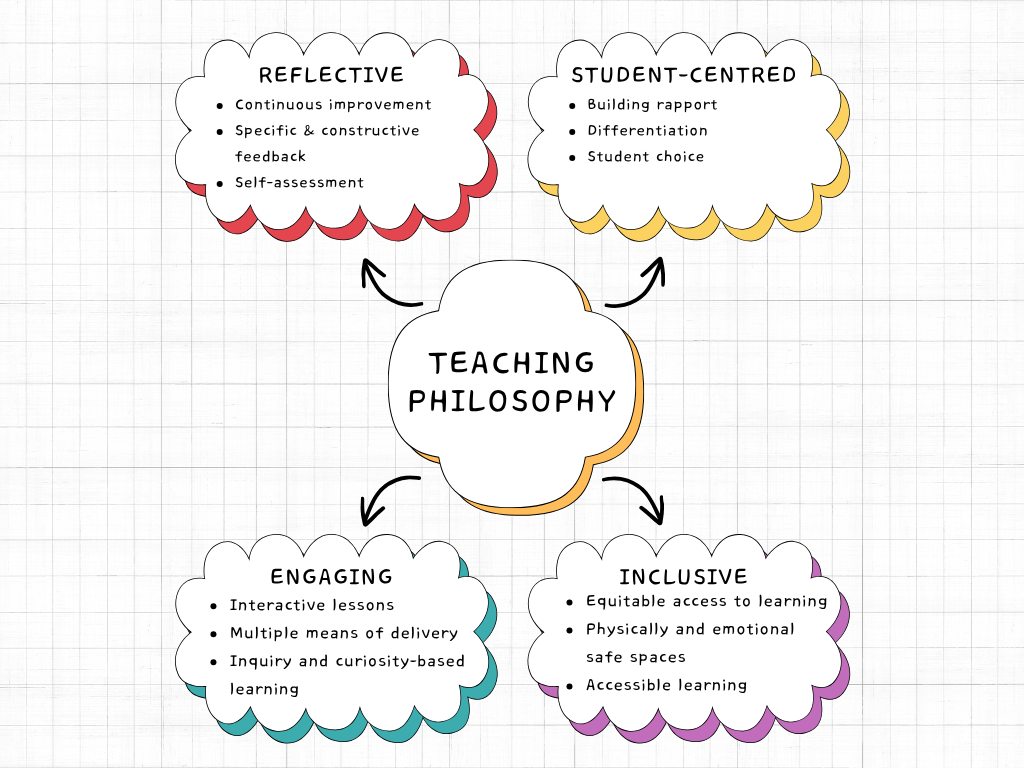
Philosophy & Artist Statement
My teaching philosophy is centred on what I believe good teaching is. I believe a good teacher is someone who is not only effective in communicating curricular material, but also someone that helps facilitate and contribute to a student-centred, inclusive, reflective, and engaging environment in partnership with their students, so that everyone feels respected and safe enough to explore and ask questions. This environment should be provided to everyone, regardless of gender identity, sexual orientation, neurodiversity, diverse learning needs, or background.
I am not just a teacher, but also a learner in this environment, and I strive to work with my students to co-create a space of respect, growth, learning, and responsibility.
To implement this definition of good teaching, I believe that it is important to help facilitate and co-create a space where everyone is accountable for being respectful of each other and their identities, histories and cultures, learning needs, and interests.
Professional Standards for BC Educators (reflections)
Standard 7: One individual professional need I have identified is utilizing more varied assessment tools. I found by experimenting with a few of them, students had better outcomes, so I would like to explore this further.
A teaching area I would like to work on in the coming year is making my lessons more accessible to a wide variety of learners, especially including ELL students. I have already explored some translation options, but I would like to engage more effective strategies, as some of my students refused to use the aids for fear of being seen as an “other”.
I will learn once I leave the program by engaging in school or district-sponsored professional development opportunities, going to relevant conferences (e.g., Catalyst), and taking courses on my own.
I have already engaged in professional development outside of the BEd program in the following ways:
- Science Teachers Association Catalyst Conference – interact and connect with other science teachers
- Indigenous Canada – to better understand Indigenous perspectives on this land
- WHMIS certification – to be better equipped in a science classroom
- FOIPPA certification – to better understand my responsibilities under FOIPPA
I believe all of these experiences helped me understand my students better, and gave me more insight in how to run a science classroom.
Standard 9: I attempt to meet Standard 9 of the Professional Standards by both explicitly tying back content to Indigenous Knowledge and the First Peoples’ Principles of Knowledge, but also in more subtle ways. I try to relate the principle of how learning supports the well-being of the self, the family, the community, the land, the spirits, and the ancestors, as well as the principle that learning is holistic, reflexive, reflective, experiential, and relational, in all of my lessons. An example of this would be a term project I gave my Biology 12 students, where students explored a piece of the course content in a context that they were interested in and could relate to. They specifically learned about how their topic can support or not support well-being, and this project helped them gain a more holistic understanding of the content and how it relates to the world around them. In this way, I try to incorporate these two principles, at minimum, and use them to guide my lesson plans, assignments, and activities. In the future, I would like to also bring in Indigenous Knowledge Keepers and incorporate Indigenous Knowledge in contexts beyond the ecological.